Environmental Contributing to a Recycling-Based Society (Circular Economy)

Policy and Basic Mindset

UBE Group Basic Policy for Circular Economy

The UBE Group will contribute to solving global environmental problems by focusing on Carbon Neutrality, Circular Economy, and Nature Positive (conservation and reconstruction of the natural environment).

Achieving Circular Economy means transforming the current linear material flow into a circular one, reusing waste and end-of-life products, and establishing an economic system that creates value.

Due to population growth and economic development, there is a growing concern about resource depletion and resource supply insecurity. Circulating limited resources supports the stability of social infrastructure.

The UBE Group will strive to realize Circular Economy.

Scope

This policy applies to the UBE Group (UBE Corporation and its consolidated subsidiaries) and covers the entire value chain.

Goal

Realizing Circular Economy

Commitment

  • We will formulate strategies that enable us to minimize risks and maximize opportunities while securing compliance with international frameworks, laws, regulations, and other rules.
  • We will reduce the volume of plastic and other waste emitted from each business base.
  • We will promote our sustainable products designed to contribute to Circular Economy.
  • Fiscal 2030 targets regarding reductions in the volume of plastic and other waste emitted from each business base and the recycling of such waste:
    • Reduction rate in the volume of waste disposed of via landfill: 50% or more (from fiscal 2022 levels)
    • Plastic waste recycling rate: 80% or more
  • Fiscal 2030 target for the promotion of our sustainable products designed to contribute to Circular Economy:
    • The weight-based sales volume of products contributing to Circular Economy: 50,000 tons or more

Responsible Departments and Review

The Sustainability Department is responsible for overseeing and managing this policy.

This Policy is subject to regular review at least once every year. Any revisions, whether as part of a scheduled review or required during the fiscal year, will be deliberated and approved by the Environmental Issues Committee.
Targets and Performance

Metrics Scope Performance Targets
FY2024 FY2030
Reduction in plastic waste sent to landfills (compared to FY2022) UBE Group 47% Over 50%
Plastic resource recycling rate UBE Group 77% Over 80%
Sales volume of products that contribute to a circular economy UBE Group 9,000 t Over 50,000 t
  • *The UBE Group’s target is based on such regulations as the Plastic Resource Circulation Act.
  • *Recycling encompasses material recycling and chemical recycling but does not include heat recovery.
  • *The definition of products that contribute to a circular economy references the recommendations made by Keidanren on realizing a circular economy on February 14, 2023, and encompass the following four categories of products.
    1) Products made using recycled materials, e.g., plastic; 2) Products made using biomass materials; 3) Products with improved durability; and 4) Products made using fossil fuel substitutes derived from captured CO2

Initiatives

Recycling of Plastic Resources

Flow of Plastic Resource Recycling

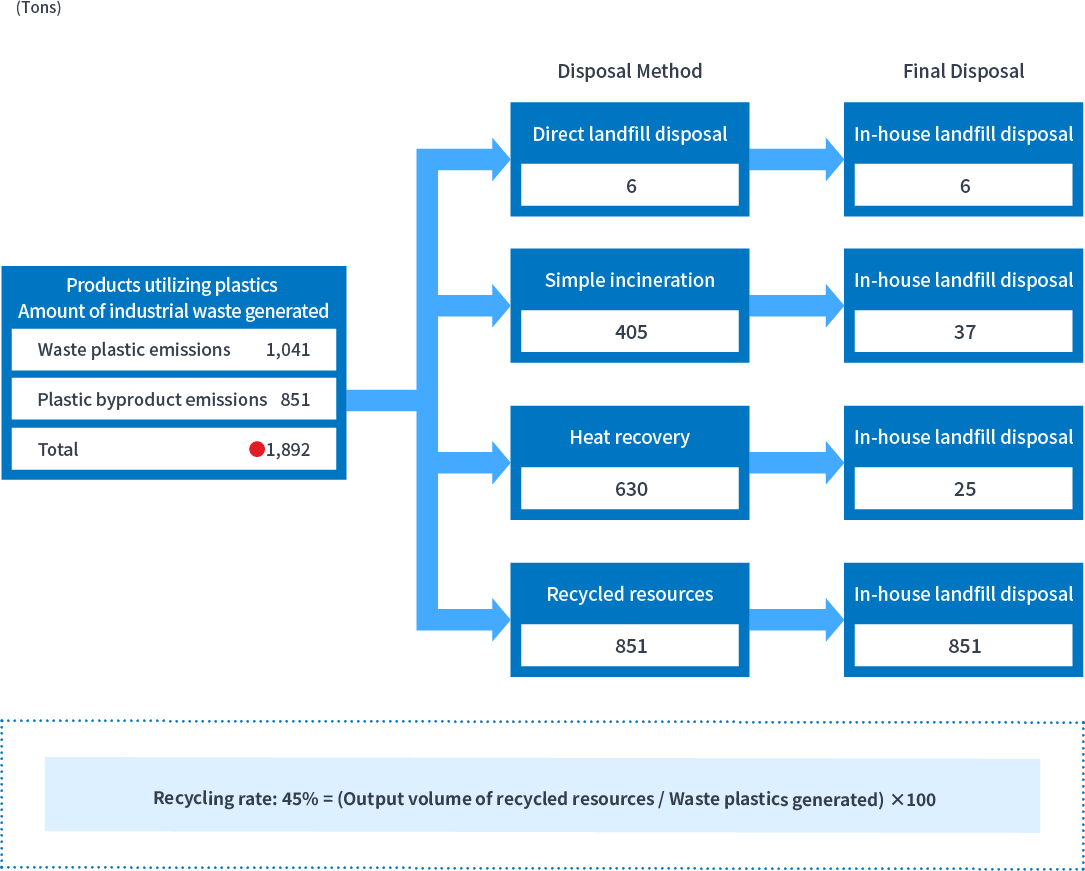
Flow of Plastic Resource Recycling (UBE Corporation, fiscal 2024 results)

: Data covered by third-party certification. Please refer to the certification document for details.

The Plastic Resource Circulation Act, which went into effect in April 2022, requires businesses to minimize and recycle industrial waste that contains plastics. UBE Corporation has striven to use plastic resources effectively and will continue to push ahead with plastic recycling.

  • Method for estimating recycling amounts: Estimated values from interview-based surveys with recycling businesses
  • Scope of coverage: Data covers seven UBE business sites. These are the Sakai Factory, Ube Chemical Factory (including the UBE Electronic and Industrial Materials Factory), Ube Chemical Factory Fujimagari Area, Ube Research Laboratory, Pharmaceutical Research Laboratory, Future Tech Laboratory, and Osaka Research & Development Center.
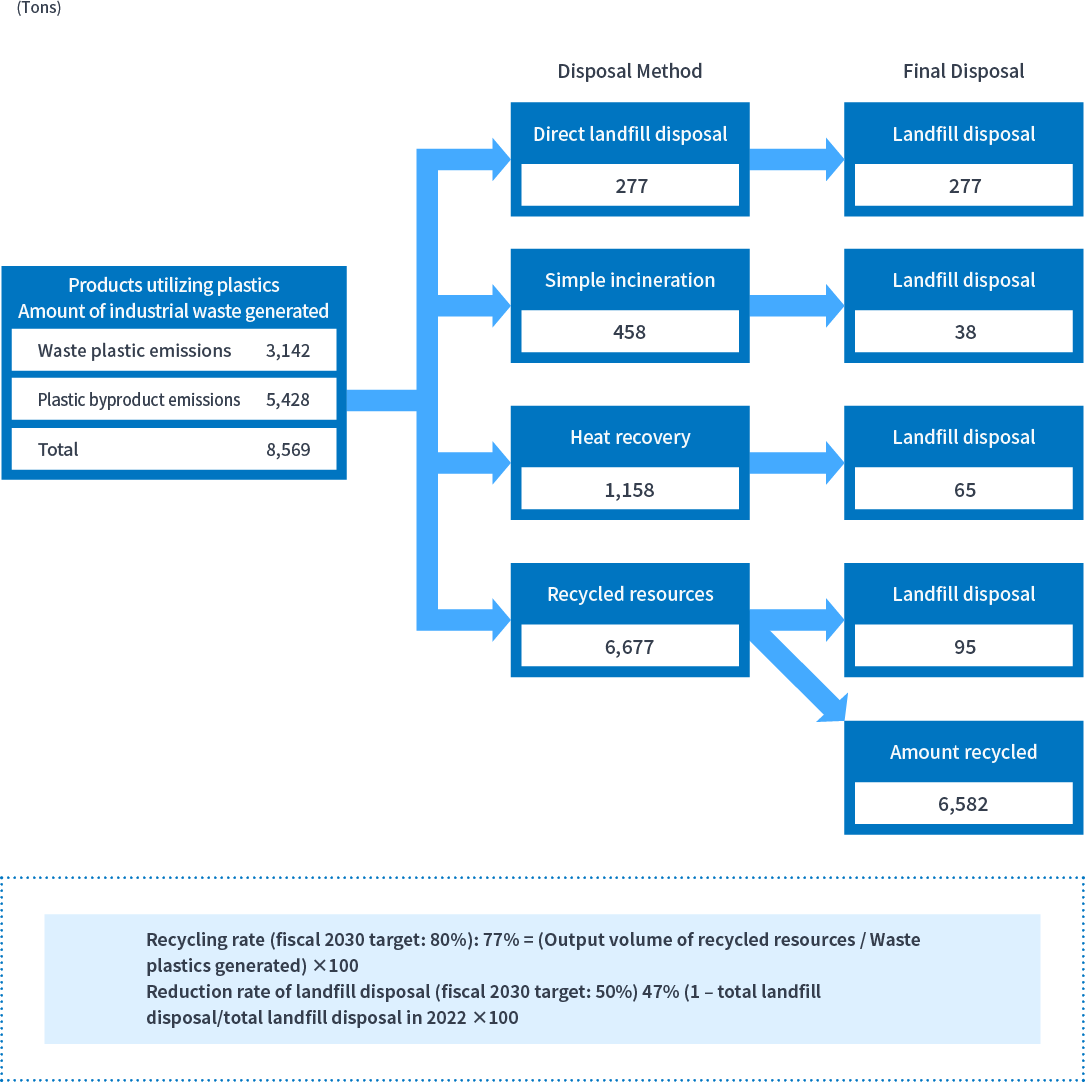
Flow of Plastic Resources at the UBE Group (fiscal 2024 results)
  • Method for estimating recycling amounts: Estimated values from interview-based surveys with recycling businesses
  • Scope of coverage: UBE Group (UBE Corporation + major domestic and international subsidiaries*)
  • *Major domestic and international subsidiaries: Ube Exsymo, Ube Maxell, Ube Film, UCE, UECI, UGT, UBE Machinery, UBE Elastomer, T&U ELECTRONICS, UBE Hydrogen Peroxide, FUKUSHIMA SEISAKUSHO, UBE STEEL

Products that contribute to a circular economy

ISCC PLUS-certified products

The ISCC PLUS certification offers international recognition of guarantees to realize sustainable supply chains. At UBE and the following Group companies, we are manufacturing and selling ISCC PLUS-certified products whose biomass and non-biological renewable content is accounted for using a mass balance method.*1

  • UBE CORPORATION EUROPE S.A.U.
  • UBE Elastomers, Inc.; our Head Office; and the Chiba factory
  • THAI SYNTHETIC RUBBERS COMPANY LIMITED Rayong Factory
  • UBE TAIWAN CO., LTD.*2
  • *1Mass balance method: A method used in the ISCC PLUS system wherein the total amount of biomass and recycled non-biological materials is compared to the total amount of nonrenewable materials utilized in a product to determine the percentage of 100% biomass and recycled non-biological materials the product contains based on the ratio comprising the two categories of materials.
  • *2Through trader certification, it is possible to handle all products recognized under ISCC PLUS.

Related links

This contains introductions to the UBE Group’s environmentally friendly products and technologies as well as the environmental product brand U-BE-INFINITY™.