UBE President
Yuki Nishida
Joined Ube Industries (now UBE Corporation) in 1987 after completing graduate studies at Hiroshima University. He has extensive experience across all aspects of the chemical business, including production, research and development, sales, and overseas assignments in Europe. He was appointed Executive Officer in 2016 and became President and CEO of UBE Corporation in 2025.
Violinist
Moné Hattori
Began playing the violin at age 5 and made her debut with an orchestra at age 8. In 2009, she made history at age 10 as the youngest person recipient of both the first and a special prize in the International Violin Competition in Honour of Karol Lipiński and Henryk Wieniawski in Lublin. Following her grand debut at age 11, she began performing and competing across Russia and Europe, receiving Grand Prix and music awards, appearing on stage with a host of renowned orchestras, and participating in a variety of concert-related activities internationally.

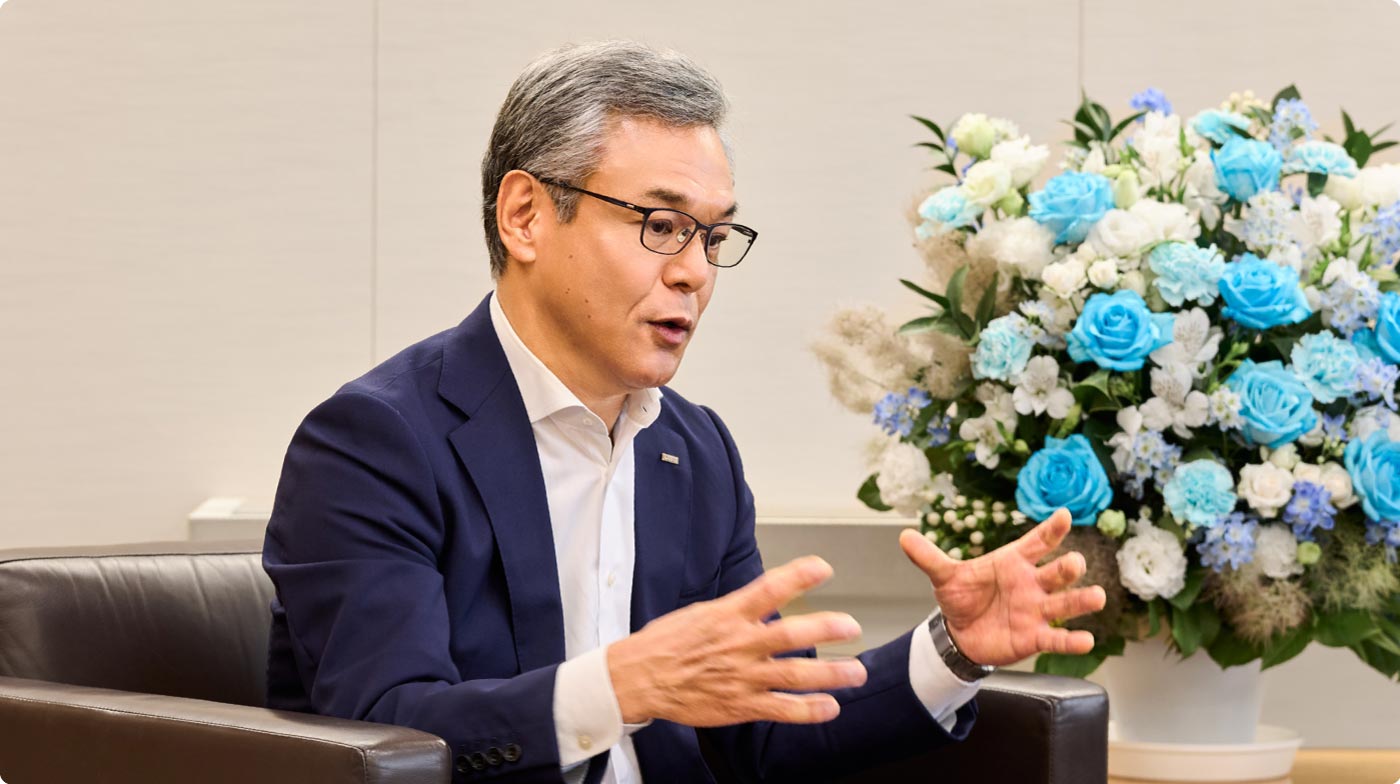
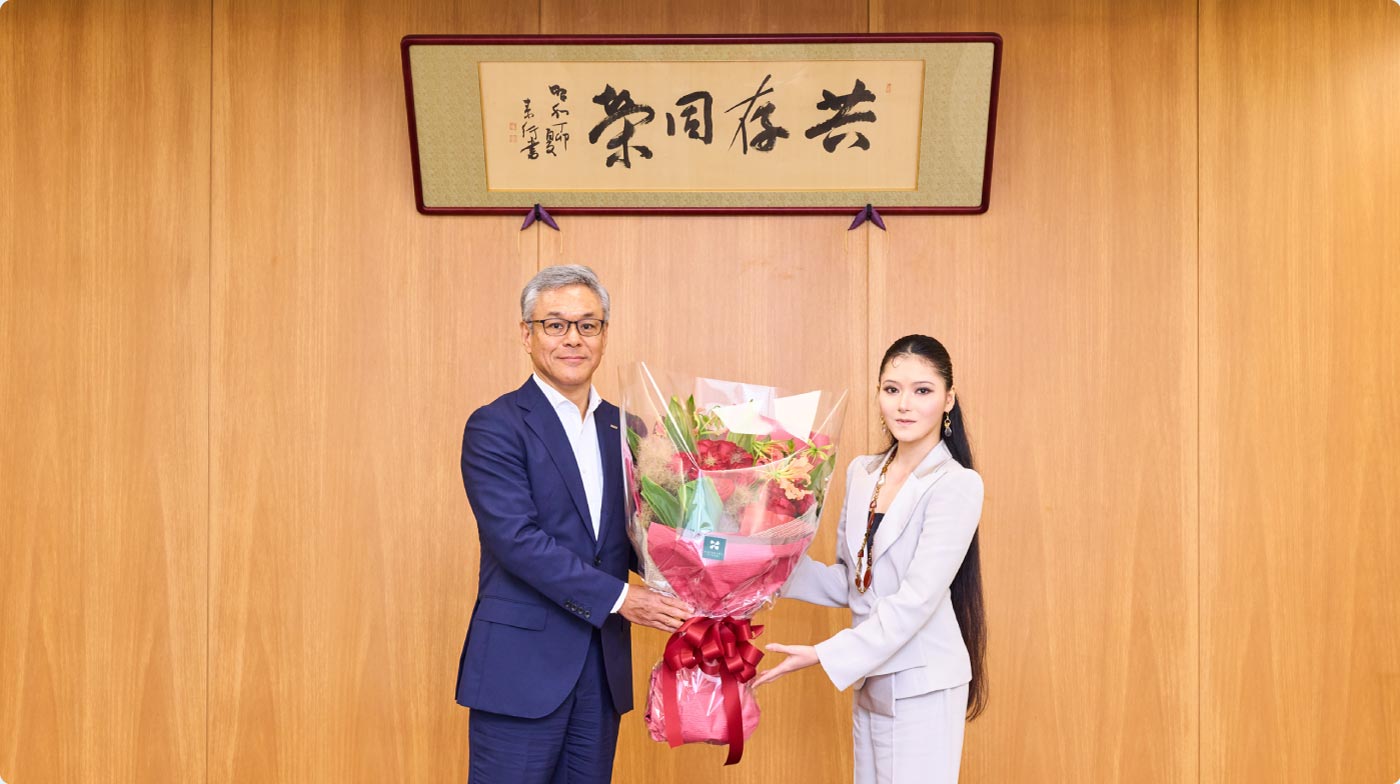
The UBE Classical Concert will be held for the 19th time this year. Prior to the concert, a special talk was held between violinist Moné Hattori, who will appear as the soloist, and UBE President and CEO Nishida.
Although music and business management are different fields, the discussion revealed many points in common. Through an exchange of experiences, perspectives, and thoughts for future generations, the two discovered new insights and created a special chemical reaction from the resonance of their convictions.
This article presents their special talk, in which the two discuss their experiences and thoughts as individuals who have continued to seek the essence of their respective fields and aim higher.
Nishida:
After celebrating the 110th anniversary of our founding in 2007, we went on to launch the UBE Classical Concert in 2008 as a project to commemorate the event on an annual basis. The purpose of this concert is to uphold one of UBE’s cherished founding principles, namely coexistence and mutual prosperity, a legacy that has been passed down through the years.
UBE started out as a coal mining business in the Ube area. As it grew, it established an array of businesses, including a chemical business that it has diversified and developed. Throughout its journey, UBE has consistently upheld the cherished values of working with and prospering alongside local communities. The UBE Classical Concert is the embodiment of our ideals of coexistence and mutual prosperity while demonstrating our desire to show our gratitude and contribute to these local communities.
Today, even though UBE is a global corporation with 55% of its net sales coming from overseas, our affection for the city in which we were founded remains unchanged. Every year, we invite superb musicians from across Japan and around the world to participate in this event and help us convey our gratitude to the residents of Ube City, and this concert has gained a place close to the hearts of many people.
Hattori:
I think coexistence and mutual prosperity are wonderful principles. And, as a violinist, I am delighted by your choice of expressing gratitude to the people of Ube City in the form of classical music.
I feel that music is a universal language with the power to bring people together. Many people in my family have been musicians, starting with my great-grandfather. I began learning to play the violin when I was five years old and have been performing in Japan and Russia since I was eight, all the while constantly honing my skills.
However, with the increase in opportunities to perform onstage, I occasionally found that I was failing to truly connect with the hearts of the audience, even when my performance was technically flawless. On the other hand, there were many times where I saw people brought to tears even when I made a mistake in a concert.
I couldn’t help but wonder why such a phenomenon would occur, but I realized that it is not technical perfection, but a musician’s love for music and the energy of their performance that moves people emotionally. I believe this is the power music holds as a universal language.
Nishida:
Listening to you speak, I really feel as though I’ve understood the ideals that are reflected in your music. I can see that you really value conveying energy and messages through the very expression of music, not just technique.
We have also inherited our founding philosophy, “From finite mining to infinite industry,” and, driven by a desire to contribute to the world through chemical operations, we continue to develop and provide materials and products that make everyday life more convenient and comfortable.
Last year, we formulated our purpose, “Breaking Through with the Chemistry of Hope,” with the aim of solving environmental problems and other difficult social issues. In support of this purpose, we also created and shared with all our employees the slogan “Facing the challenges of an uncharted future.”
Hattori:
Much like what you describe, musicians are the inheritors of works of composers long past and take on the responsibility of reproducing them for present-day audiences. In this way, I feel as though there are commonalities between corporate activities and music-related endeavors.
Also, putting on concerts is expensive and entails risks that must be managed, which can bog you down and make it impossible to move forward. That’s why I feel inspired by the phrase “Breaking Through with the Chemistry of Hope.” I want to continue bringing beautiful music to audiences around the world by believing in the power of music and being unafraid of risks.
Nishida:
Thank you so much. When promoting our purpose and this slogan, I find it is important to create opportunities for me to do so in my own words through direct face-to-face interactions with employees. I’ll often sit in a circle with younger employees so we can speak passionately about our ideals. After these sessions, I’ve been told many times that hearing my thoughts on a subject has helped people understand these concepts.
Hattori:
I wouldn’t have expected a president to speak directly with their employees. I thought that corporate culture involved disseminating such essential matters on printouts or by e-mail, but I agree with your focus on face-to-face interactions. I believe that passion and ideals are best conveyed in settings where the parties involved share time and space. If I were an UBE employee, I would really cherish such an enthusiastic president. (Laughs)
Certain things about concerts happen only in that particular setting—for example, a venue’s atmosphere, a performer’s enthusiasm, and the feeling of oneness with an audience. Such once-in-a-lifetime moments inspire musicians to strive for greatness, leading to truly moving performances.
Hattori:
I really feel as though our discussion has touched on similarities between management and orchestras. An orchestra’s maestro (conductor) must understand the individual mindset and characteristics of each soloist and performer to effectively direct a concert. At the same time, the maestro is also responsible for letting each musician’s individuality shine through while guiding the entire group toward the best possible performance.
Similarly, you must be guided by your company’s purpose to safely direct it through this new era while working to communicate that purpose to every employee via face-to-face conversations. It seems to me that these two “directing” processes are much the same, but I’m interested in hearing your feelings on the subject.
Nishida:
It’s certainly vital that corporate managers clearly indicate the direction everyone should be taking. However, it is an impossible task for a single manager acting alone. Each individual employee must adopt these principles and work together with others to bring their capabilities to bear along a common path. For this to happen, it is necessary for me to convey the desired outcome for the organization while also creating as many opportunities as possible to speak with employees, but could you tell me what an orchestra is like?
Hattori:
Over a long course of constant rehearsal, an orchestra creates a coherent outcome through trial-and-error. As differences of opinions between maestros and performers become apparent, they are resolved through communication, for example, by sharing and discussing ideas. This process enables dozens of performers to present a unified front in a concert.
Nishida:
When I began working, I was assigned to the R&D Department, so I have plenty of experience developing new techniques and products through constant experimentation. However, it’s impossible to create something new without going through this process. Both music and chemistry evolve and grow by perpetually challenging the status quo.
Nishida:
I hear that, just as each performer is unique, each instrument is also unique. Could you tell me about the Guarneri del Gesù violin that you play?
Hattori:
Stradivarius violins are quite famous, but mine is a Guarneri del Gesù. The two are considered by many to be rivals, and while Stradivarius instruments produce a characteristically uniform and smooth sound, the tone of Guarneri del Gesù violins is rougher and sharper. Even though playing such an instrument effectively feels like trying to ride a wild horse, I prefer the Guarneri del Gesù style.
Nishida:
So, instruments can be very different depending on the maker. I was shocked to hear that yours has been in use for hundreds of years.
Hattori:
Violin wood breathes. If you seal such an instrument in a glass case, the wood can’t breathe and the cells die, rendering the instrument unable to produce a good sound. That’s why instruments that have continued to be played by performers across multiple eras endure. Exterior varnish is also important, and since the one on my instrument was applied 300 years ago, it produces an exquisite sound. At the moment, the relationship between sound and varnish has yet to be explained, but I think that the mystery could be solved through the power of science, which in turn could cause instruments themselves to change greatly. Examples like this show how many aspects of music are actually based in science, even though music is often considered to be an abstract art.
Nishida:
It’s certainly a sustainable practice to continue using an instrument created long ago by a famous maker. Wonderful pieces and instruments created centuries ago are brought back to life in the form of music without losing any of their appeal. I feel more interested in classical music than ever after speaking with you today, Ms. Hattori.
Nishida:
Could you please give a message to the people of Ube City, who are looking forward to the 19th UBE Classical Concert?
Hattori:
This concert will include Brahms’s Violin Concerto and Symphony No. 1, which are very lively and passionate pieces. I think that just listening to them will inspire optimism and energize the audience.
Although the concerto delivers a huge maelstrom of energy to the audience thanks to the communication between the maestro, soloist, and orchestra, the performance is not just a presentation of music. It is only complete when the audience hears and appreciates it.
I will be putting my heart and soul into the performance, so I hope that you all will be able to feel my passion.
Nishida:
I feel it is the mission of performers to convey the ideals and messages embodied in music to a great many people. This discussion reacquainted me with the appeal of classical music, and I look forward to hearing this concert in Ube City. I would also like everyone in Ube City to truly enjoy the music that will be played by international performers such as yourself, Ms. Hattori, and the Japan Philharmonic Orchestra, which represents our nation on the world stage.
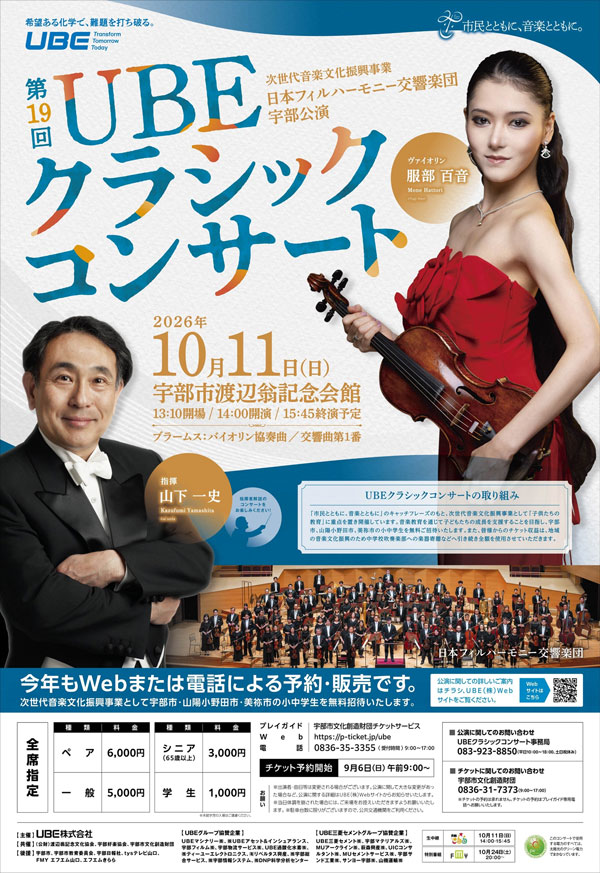
Based on the concept of “Together with the Community, Together with Music,” the UBE Classical Concert is held as a music culture promotion project targeting the next generation. Its purpose is to support the growth of children through music, and elementary and junior high students from Ube City, Sanyo-Onoda City, and Mine City are invited to attend free of charge. A portion of ticket proceeds are used to promote local music culture.
For the 19th Concert, we have invited the conductor Kazufumi Yamashita, the soloist Moné Hattori (violin), and the Japan Philharmonic Orchestra to perform Brahms’s Violin Concerto in D Major, Op. 77 and Symphony No. 1 in C Minor, Op. 68.
Date: October 11, 2026 (Sunday)
Location: Ube City Watanabe Memorial Hall
For details on the profiles of performers, ticket information, etc., please refer to this flyer (Japanese only).